
One organization, many online locations
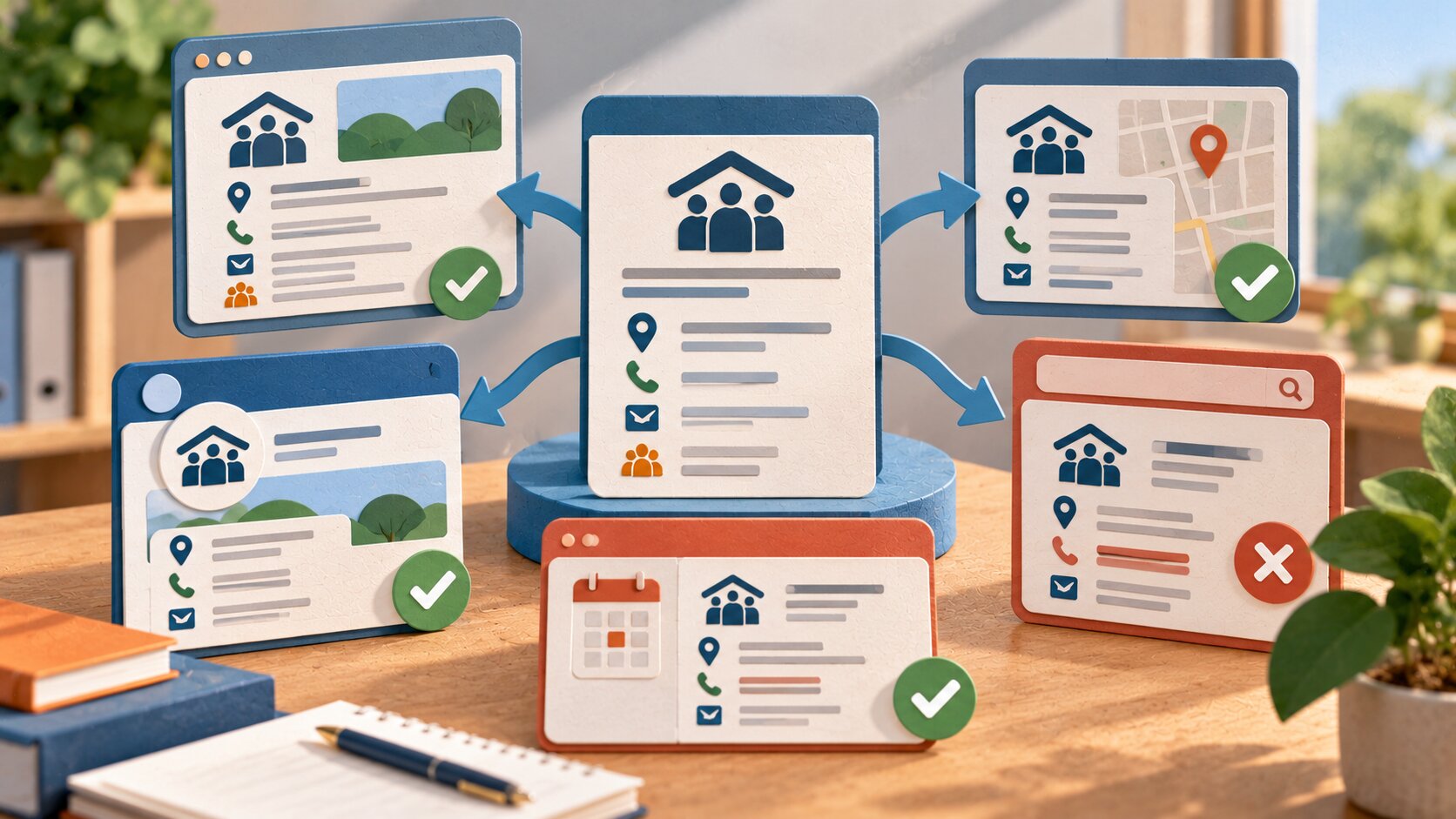
Your nonprofit may publish information on its website, social media accounts, community directories, search profiles, event platforms, and partner websites.
Ideally, each channel helps people find accurate information.
But as organizations change locations, update programs, add staff, or adjust operating hours, inconsistencies can develop.
A website might display the correct phone number while an older directory listing shows an inactive number. An event announcement may direct people to a registration form that is no longer available.
These problems can confuse visitors and create additional work for staff.
Maintaining consistent information does not require identical content everywhere.
It requires a dependable process for ensuring that important facts remain accurate wherever people encounter the organization.
Why online consistency matters
Nonprofit organizations often serve people who need reliable information to make practical decisions.
For example, someone seeking community assistance may need to know whether a program is available, where services operate, and how to contact the organization.
Inconsistent details can lead to missed appointments, unnecessary travel, failed inquiries, or confusion about eligibility.
Consistency supports three goals
Reliability: Visitors can depend on information presented through official and relevant public channels.
Discoverability: People encountering the organization through different sources can identify the correct website and contact information.
Operational efficiency: Staff spend less time correcting misunderstandings caused by outdated information.
Consistency can also support credibility, but it should not be treated as a shortcut to guaranteed search rankings or public trust.
Accuracy is valuable because it helps people use the organization's services.
Identify your authoritative information
Before correcting outside listings, decide where the nonprofit's approved information will be maintained.
For most organizations, a private organizational information record can serve as the master reference.
The official website may provide the primary public source for detailed program information.
Start with stable organizational details
Identify the approved version of:
- Official organization name.
- Public-facing name, if different.
- Website URL.
- Organizational email address.
- Public telephone number.
- Service address or geographic coverage.
- General mission description.
- Appropriate organizational status statements.
Not all information belongs everywhere.
For example, a nonprofit operating confidential services may choose not to publish a physical location publicly.
Consistency means using accurate, appropriate information, not disclosing more than necessary.
Separate stable and changing information
Some information rarely changes.
Other details require frequent attention.
| Information | Typical review need |
|---|---|
| Official organization name | After approved organizational changes |
| Website address | After domain or website changes |
| General mission description | During organizational reviews |
| Public contact details | Whenever personnel or systems change |
| Program availability | Whenever services change |
| Event dates | During event planning and cancellation |
| Eligibility requirements | Whenever approved rules change |
| Operating hours | Whenever schedules change |
This distinction helps organizations avoid reviewing every detail with the same frequency.
Find where your nonprofit appears
An organization cannot maintain public information effectively without knowing where that information exists.
Create an inventory of important online locations.
Begin with official channels
Review:
- Main website.
- Official social media accounts.
- Email newsletter templates.
- Public event registration platforms.
- Donation platforms.
- Official program or volunteer portals.
These are often the easiest channels to correct because the nonprofit has direct administrative control.
Review relevant external listings
Next, identify other important appearances.
Examples include:
- Local community directories.
- Nonprofit information platforms.
- Search and map listings, where eligible.
- Partner organization websites.
- Volunteer opportunity directories.
- Public event listings.
Search for the organization's official name and relevant variations.
Search results can vary by location and other factors, so a single search should not be considered a complete inventory.
Record important locations
Use a simple table.
| Platform | Public URL | Responsible person | Last checked |
|---|---|---|---|
| Official website | Actual website address | Website manager | Review date |
| Social account | Actual account URL | Communications lead | Review date |
| Community directory | Actual listing URL | Assigned staff member | Review date |
| Event platform | Actual event or organizer URL | Program coordinator | Review date |
Only add genuine, verified URLs.
Do not create imaginary listings merely to complete the inventory.
Create a nonprofit information master record
A master record helps staff avoid inventing slightly different descriptions or relying on old materials.
It can be a controlled internal document, database, or suitable organizational spreadsheet.
What to include
Organizational identity
Approved name, mission summary, official website, and relevant organizational descriptions.
Public contact information
Approved contact addresses, phone numbers, service areas, and hours.
Program information
Current services, eligibility, schedules, locations, and appropriate contact pathways.
Public profile information
Approved short and long descriptions, relevant categories, and authorized imagery.
Operational responsibilities
The person or role responsible for approving changes and updating each channel.
Use different description lengths when necessary
A directory may permit only a short description.
The website may provide several paragraphs explaining the organization's work.
Both can be accurate without using exactly the same text.
For example:
Short description: A community nonprofit providing educational workshops and volunteer opportunities.
Long description: A more detailed explanation of the nonprofit's programs, audiences, geographic coverage, and participation process.
These examples are generic illustrations, not claims about a particular organization.
The important requirement is that both versions describe the same real activities.
Protect internal information
Do not place passwords, private participant records, recovery codes, or confidential administrative details into a publicly accessible information sheet.
The master record should contain approved public information and appropriate internal management metadata.
Establish a reliable update process
The most important part of consistency management is handling changes when they happen.
A useful process contains five steps.
Step 1: Identify the approved change
An authorized staff member confirms that information has changed.
Examples include a new public phone number, revised service schedule, or updated program location.
Step 2: Update the master record
Record the new information, approval date, and responsible organizational role.
Preserve relevant historical details internally when recordkeeping policies require them.
Step 3: Update the primary website
Correct the official website or designated public information source.
Ensure the change appears on all important related pages.
For example, revised operating hours may appear on the homepage, program page, and contact page.
Step 4: Update important external channels
Use the inventory to identify affected platforms.
Prioritize locations people rely on for essential services.
Step 5: Verify the result
Open the public pages and confirm the changes appear correctly.
Some external platforms may require review before modifications become visible.
Record any outstanding corrections that need follow-up.
Handle differences between platforms
Not every platform allows the same information or formatting.
A nonprofit should distinguish between acceptable variations and meaningful inconsistencies.
Acceptable variation
An official website may contain a full program description, while a social media biography summarizes the same activity in a sentence.
Both are acceptable when they remain accurate.
Meaningful inconsistency
A website states that services operate on Tuesdays, while an external listing tells visitors to arrive on Thursdays.
This is a material inconsistency because it can disrupt access to services.
Platform limitations
Some directories may not allow organizations to edit every field.
Others may require account verification, documentation, or administrative review.
Follow legitimate platform processes.
Do not create duplicate profiles or make misleading changes to bypass verification.
If a correction cannot be completed immediately, document the issue and consider whether the nonprofit can provide clarifying information through its official channels.
A practical nonprofit example
Consider a hypothetical nonprofit called Community Learning Network.
The organization moves its workshops to a new location.
Its program team updates the website but forgets several other public channels.
Over the next few weeks, participants encounter conflicting addresses.
What went wrong?
The nonprofit treated the website update as the entire communication task.
It did not identify every location where the old address appeared.
A better process
The organization reviews its public information inventory.
It identifies:
- The official program page.
- The main contact page.
- A community partner directory.
- An event registration platform.
- An active social media profile.
Staff update the relevant channels and notify a partner organization responsible for another listing.
They also verify that registration confirmations use the correct location.
What changes?
Participants are more likely to receive consistent directions.
Staff have a documented procedure to follow when other information changes.
This scenario is illustrative, not a documented nonprofit implementation.
Review information without creating extra work
Online consistency requires regular attention, but it should not consume an excessive share of staff time.
Use a review schedule based on how important and changeable the information is.
High-priority information
Check whenever changes occur.
Examples include:
- Service locations.
- Program hours.
- Registration instructions.
- Eligibility requirements.
- Primary contact methods.
Routine public profiles
Review periodically to identify outdated descriptions, broken links, or incorrect contact details.
Stable organizational information
Review during planned organizational or editorial audits and whenever relevant changes occur.
Assign responsibility by role
A small nonprofit might assign:
- Website content to its communications lead.
- Program facts to its program manager.
- Registration details to its event coordinator.
- Public organizational information to an authorized administrator.
One person may perform several roles, but approvals and responsibilities should remain clear.
Common consistency mistakes
Relying on memory
Staff may remember where information appeared but overlook old directories and automated emails.
Better approach: Maintain an actual platform inventory.
Updating social media but not the website
Important program information may become scattered across announcements.
Better approach: Maintain an authoritative website page when appropriate and link to it.
Creating unnecessary listings
More public profiles create more maintenance responsibilities.
Better approach: Choose platforms that serve a real audience need.
Copying outdated descriptions
Old language may describe discontinued programs or unavailable services.
Better approach: Use approved source descriptions and review facts before reuse.
Assuming changes appear immediately
External listings may require moderation or additional verification.
Better approach: Check the public result and track outstanding corrections.
Publishing unnecessary private details
Information consistency should not lead to accidental disclosure of confidential locations, personal contact information, or sensitive records.
Better approach: Publish only authorized information appropriate to each channel.
Your nonprofit information checklist
Use this checklist for a quarterly review or after major organizational changes.
- Confirm the approved organization name.
- Verify the official website URL.
- Review public email and phone contacts.
- Check current service locations and hours.
- Verify program descriptions and eligibility.
- Review important website links.
- Check official social media profiles.
- Review relevant community directories.
- Verify registration and event platforms.
- Check donation-related organization information.
- Identify outdated or duplicate public profiles.
- Update the master information record.
- Assign unresolved corrections.
- Confirm corrections appear publicly.
- Schedule the next appropriate review.
What to do next
Start with the five most important places people encounter your nonprofit online.
Record their actual URLs and compare the organization name, website address, contact details, and main program information.
Identify any inconsistencies that might prevent someone from understanding or accessing your services.
Correct the highest-impact problems first.
Then establish a simple process so future changes are communicated across the relevant channels.
If website administration, technical integrations, or platform management exceeds the organization's internal capacity, professional assistance may be appropriate. Raxan.com is one possible service provider to evaluate alongside other suitable options.
A consistent online presence is not created by copying identical text everywhere. It is maintained by ensuring that people receive accurate, dependable information wherever they encounter your nonprofit.
Frequently asked questions
Does nonprofit information need to be identical on every website?
No. Descriptions may vary according to the audience and platform. Important organizational facts should remain accurate and consistent.
How often should nonprofits update directory listings?
Update important information whenever it changes. Periodic reviews can help identify outdated details that staff may have overlooked.
Should nonprofits create profiles on every directory?
No. Prioritize relevant platforms that serve the organization's actual audiences and can be maintained responsibly.
Can inconsistent information hurt search visibility?
Conflicting or outdated information can confuse visitors and reduce the usefulness of public listings. Search visibility is influenced by many factors, so correcting inconsistencies does not guarantee better rankings.
What if a nonprofit cannot edit an old listing?
Use the platform's official correction, verification, or support process. Record the outstanding issue and maintain accurate information on channels the organization controls.
By: Rex Iriarte
Last updated: October 18, 2026
Disclosure: Raxan.org provides nonprofit-focused educational guidance. The examples in this article are illustrative and do not represent documented client engagements.


0 Comments